
Michel Maffesoli : ‘Today’s modern democratic ideal has expired’
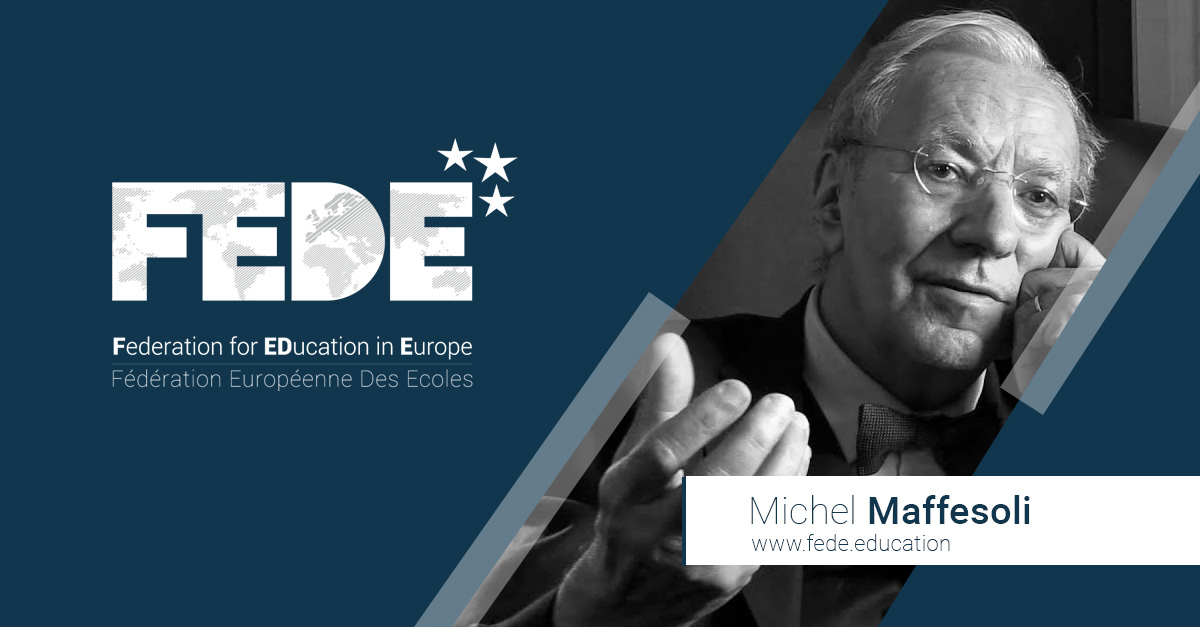
Michel Maffesoli, honorary professor at the Sorbonne and a founding member of the FEDE’s Academic Council, is a leading figure in European intellectual circles. While his analyses tend to stir up and unsettle his audience, hey are always full of sense. Read on to find out his views on the recent French municipal elections.
What’s your reaction to the results of the recent elections?
What’s striking is not so much the rise of the greens (a few groups of would-be green, power-starved yuppies have capitalised on the trend for green) but rather the tremendous lack of interest for the local elections amongst ordinary people. Nobody – be it the traditional parties, the pseudo-new forms of representation (the ‘neither left-wingers nor right-wingers’ of La République En Marche) or even political ecology – can claim that they represent the people, let alone that they bring together the diverse elements of a Single and Indivisible Republic.
How would you explain this lack of interest?
By a divorce between power and puissance. To put it succinctly, power is instituted; it’s the organisation of society (elections and the elected). Puissance, on the other hand, institutes. Puissance embodies and gives sense to life and society; it’s at the basis of collective living (the desire of voters).
In modernity (from the Enlightenment to our days), people have delegated power to various elected bodies that are given a mandate to implement a programme and embody a given conception of society. With the emergence of postmodernity – that is, in a tribe-based society made up of multiple communities – this type of delegation no longer works. The masses are fragmented – scattered amongst numerous different tribes – and no longer feel represented. People no longer identify with a single model that transcends every aspect of their economic, social and spiritual lives.
What do you think will be the consequences?
When power and puissance are completely dissociated, when institutions are no longer fuelled by a shared energy, that is, by popular puissance, when the elites are very remote from ordinary people, one needs to find new ways of managing society.
Incidentally, note what happened in a small number of municipalities of fewer than 1000 inhabitants, where the previous representatives were not re-elected in the first round of the elections. In fact, teams of people had come to the fore who wished to revitalise their village by means of collaborative projects and innovative forms of participation.
Can you say a bit more?
Experienced politicians were pulling various strings in our decaying democratic life in order to prevent these experimentations from happening. But in both towns with a high abstention rate and villages where the powers that be have clung onto their privileges, new forms of social administration will appear progressively through collective experimentation: popular uprisings, as per the early gilets jaunes, or demonstrations of various kinds that aim simply to bring people together. We are also going to see acts of solidarity, mutual assistance, festive gatherings and meetings that will emerge as part of daily life at a local level.
What form will postmodern institutions take?
Policies imposed from above – policies fixed by elites leading people towards a goal chosen by these decaying elites themselves – no longer work. They are a thing of the past. However, no one can say what form the institutions that emerge from the new social dynamics will take. Doubtless there will be numerous upheavals and clashes between puissance and the declining power. What is clear, on the other hand, is that the new, transfigured politics can be seen emerging day by day at a local level, in everyday proxemics. In postmodernity (as opposed to modernity) society is not constructed through planning for the future but simply through being together in a given place. Shared experience will take the place of any catalogue of promises.